
New Alzheimer’s Association Report Finds Alzheimer’s Burden Continues to Grow in North Carolina
The Alzheimer’s Association 2022 Alzheimer’s Disease Facts and Figures report just released provides an in-depth look at the latest statistics on Alzheimer’s prevalence, incidence, mortality, costs of care, dementia care workforce and impact on caregivers across the country and in North Carolina.
“The new Facts and Figures report clearly outlines the burden that many North Carolina families are going through. These findings drive home the fact that at the Alzheimer’s Association, our mission is clear – we must continue to support all those affected by Alzheimer’s and dementia with our local care and support services and continue to fund critical research.”
Katherine L. Lambert, Alzheimer’s Association Regional Leader for the NC, SC, and GA Chapters
Here are the biggest takeaways from this year’s report for North Carolina:
More Americans are living with the disease
An estimated 6.5 million Americans age 65 and older had Alzheimer’s dementia in 2021.
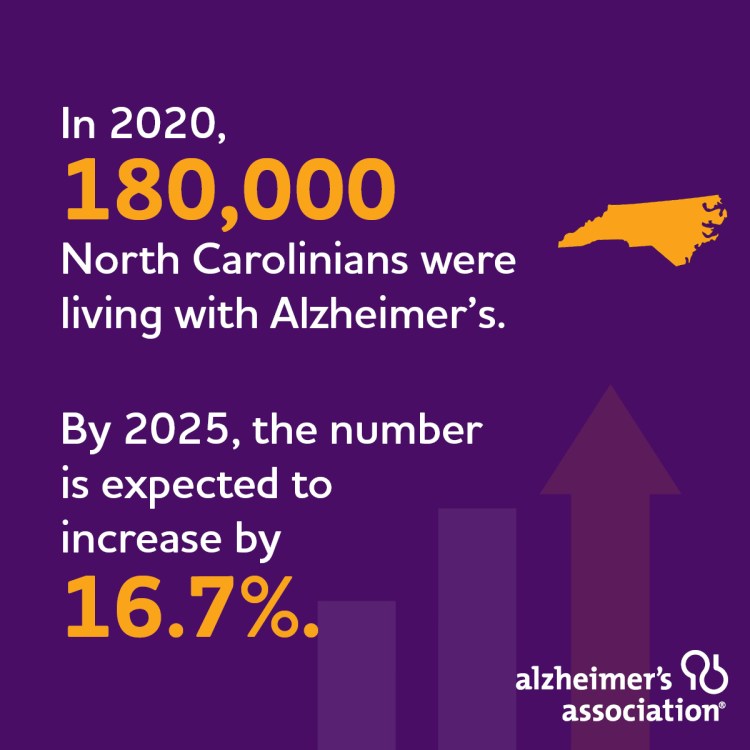
- This includes 180,000 in North Carolina alone.
- It is estimated that this number will rise to 210,000 by 2025.
Alzheimer’s is a leading cause of death
Deaths due to Alzheimer’s have increased an alarming 145% since 2000.
- In North Carolina, there were 4,508 deaths, a 161% increase.
Many family and friends are serving as Alzheimer’s caregivers
More than 11 million caregivers of people with Alzheimer’s disease or other dementias.
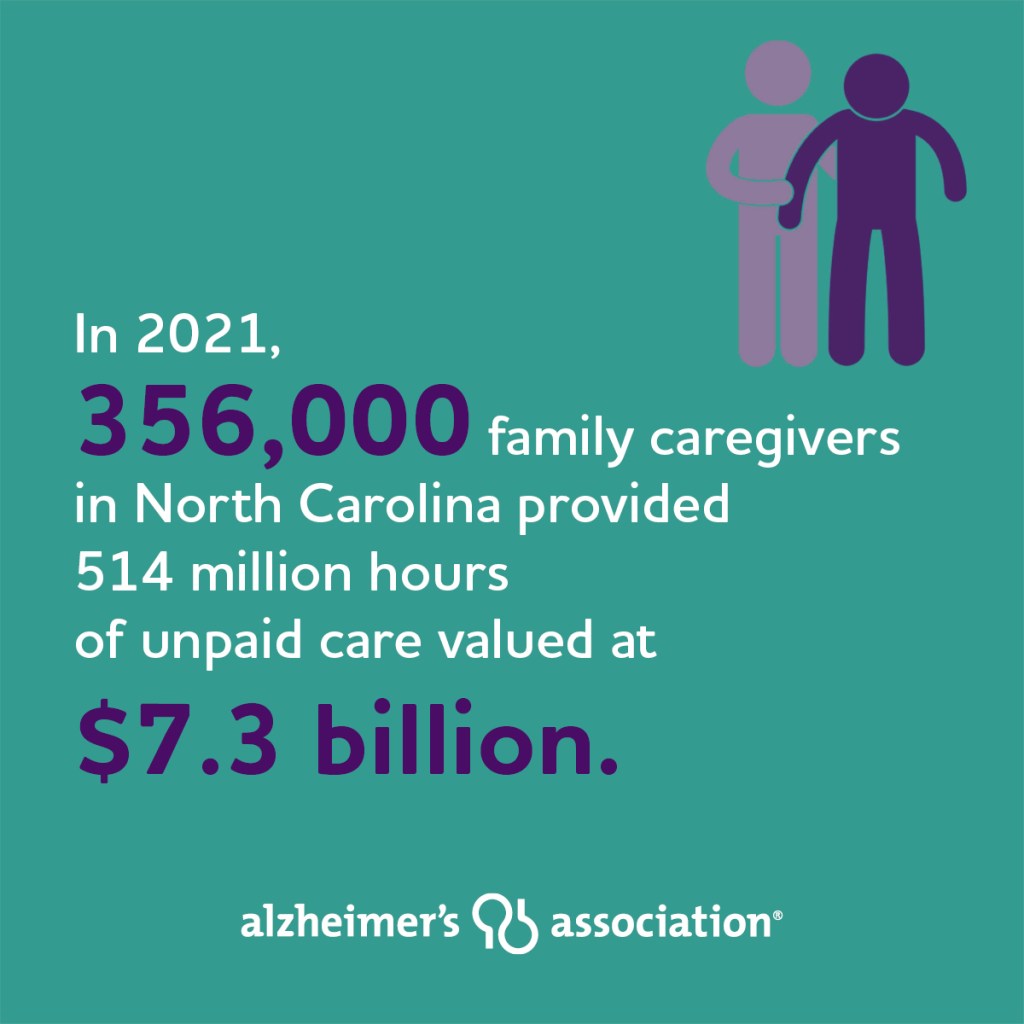
- In North Carolina, 356,000 caregivers provided a total of 514 million hours of unpaid care, valued at a total of $7.3 billion.
The costs are unsustainable
In 2021, it is estimated dementia caregivers bore nearly twice the average out-of-pocket costs of non-dementia caregivers, having to cover medical care, personal care and household expenses for the person with dementia.
- In 2022, the total national cost of caring for individuals with Alzheimer’s and other dementia is projected to reach $321 billion.
- Here in North Carolina the Medicaid costs of caring for people with Alzheimer’s are estimated at $1.3 billion.
- By 2025, these costs are projected to increase by 22%.
Significant shortage in dementia care workforce will affect care
As the prevalence of Alzheimer’s disease increases here in North Carolina, so does the need for members of the paid dementia care workforce who are involved in diagnosing, treating and caring for those living with the disease.
- For the first time, the report looks at the dementia care workforce and whether it is meeting the demands of the growing number of people being diagnosed. In North Carolina, there are 158 geriatricians.
- By 2050, that number needs to increase by 238% to meet the care demands of those age 65 and older.
- There are 63,400 home health and personal care aides in North Carolina, but we need to increase that number by 23% by 2028 to meet projected care demands.
The shortage of specialists is a barrier to a timely and accurate diagnosis, and a lack of diagnosis means a delay in treatments, care delivery and supportive services.

Special Report Finds Doctors and the Public Face Challenges in Understanding and Distinguishing Early Alzheimer’s Development from “Normal Aging”
An accompanying special report, “More than Normal Aging: Understanding Mild Cognitive Impairment (MCI),” for the first time examined both public and primary care physicians’ (PCP) understanding of real-world awareness, diagnosis and treatment of MCI and MCI due to Alzheimer’s disease in the United States.
The report unearthed challenges both doctors and the American public face in understanding and diagnosing mild cognitive impairment (MCI), which is characterized by subtle changes in memory and thinking. It is estimated 10% to 15% of individuals with MCI go on to develop dementia each year. And as the size of the U.S. population age 65 and older continues to grow (from 58 million in 2021 to 88 million by 2050), so too will the number and proportion of Americans with Alzheimer’s or other dementias given increased risk of dementia with advancing age.
“Mild cognitive impairment is often confused with ‘normal aging,’ but is not part of the typical aging process,” said Maria Carrillo, Ph.D., chief science officer, Alzheimer’s Association. “Distinguishing between cognitive issues resulting from normal aging, those associated with MCI and those related to MCI due to Alzheimer’s disease is critical in helping individuals, their families and physicians prepare for future treatment and care.”
Full text of the Alzheimer’s Association 2022 Alzheimer’s Disease Facts and Figures report, including the accompanying special report, “More than Normal Aging: Understanding Mild Cognitive Impairment (MCI),” can be viewed at alz.org/facts.
About 2022 Alzheimer’s Disease Facts and Figures:
The Alzheimer’s Association 2022 Alzheimer’s Disease Facts and Figures report is a comprehensive compilation of national statistics and information on Alzheimer’s disease and related dementias. The report conveys the impact of Alzheimer’s on individuals, families, government and the nation’s health care system. Since its 2007 inaugural release, the report has become the preeminent source covering the broad spectrum of Alzheimer’s issues. The Facts and Figures report is an official publication of the Alzheimer’s Association.
 Alzheimer's Association North Carolina Blog