
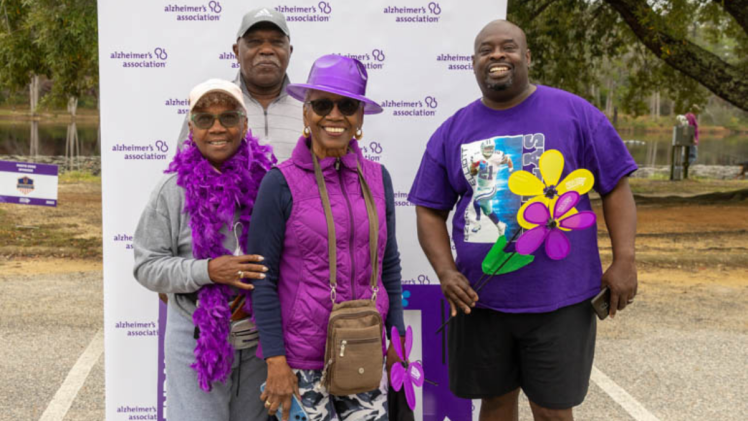
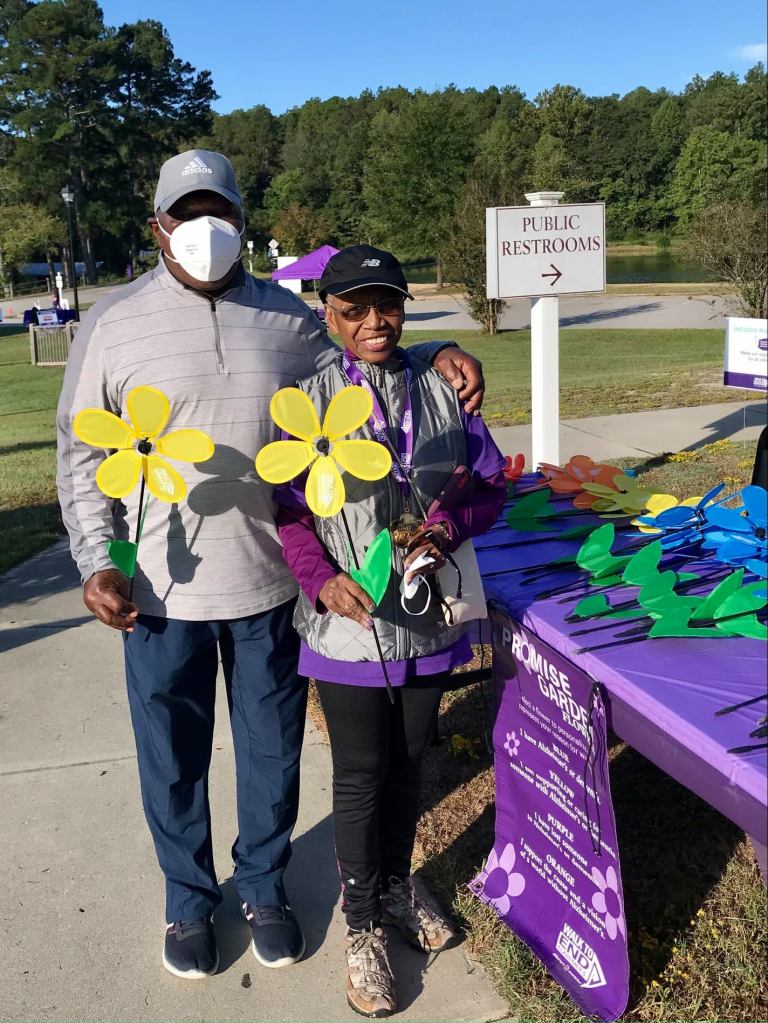
A self-described daddy’s girl, Charlie Laird jokes her father really wanted a boy but upon learning that his first child was a daughter, he still wanted to proceed with the plan to continue the Charlie name in the family. Charlie’s petite frame, sweet demeanor, and smile is no stranger to the Walk to End Alzheimer’s, as she is usually among the first to arrive on Walk Day. She walks with her husband, John, and their friends, carrying the Purple Promise Garden Flower. To her, this fight is personal, as she served as a caregiver for both her father and stepmother who battled this devastating disease. Now, Charlie is preparing for her fifth year participating in the Walk to End Alzheimer’s – Moore County, on September 30, as the team captain of her Walk Team, Charlie Roundtree — aptly named in honor of her father’s memory.
When Charlie’s mother passed away of stomach cancer at age 48, Charlie Sr. focused on his daughters, Charlie and Louise, and his barbershop business. Later, he met Dora, a beautician, in 1965 and they fell in love. The husband and wife duo of Charlie and Dora would walk mere steps from the front door of their home in Southern Pines each weekday to their workplace — a combination barbershop and salon — to serve their customers with all that a good haircut provides: necessity, style, a listening ear, and confidence. Charlie Sr. was also known to often serenade their clientele, in addition to bearing the barber shears, while in the salon chair. His singing went beyond the business, as a vocalist on the praise and worship team and the Chairman of Deacons in their home church of First Missionary Baptist Church. For 31 years, Charlie and Dora shared a business, family, and adventures. The one thing they didn’t know they’d share: a disease that robbed them of their memories.
As daughter Charlie expresses, “It was the double whammy that no one expected”. Her father began to show signs of Alzheimer’s disease in the early eighties. Dora shared with them frequently in phone conversations that there was something wrong with their daddy. Charlie had moved to Michigan with her family and Louise was in Maryland. At the time, there was a lack of information available about the warning signs of Alzheimer’s disease, so there was a misperception at to what was truly going on. In 1986, Charlie recalled an incident that was the catalyst to the family seeking medical help for their patriarch. Her dad got lost coming home after dropping a friend off in Raleigh. With there being no such thing as a cell phone yet, Dora sought help from the police when Charlie Sr. did not return home in a timely manner. To the family’s relief, the police found him in his car beside the highway very upset and confused, but unharmed. Upon consulting with his primary care physician and a neurologist, Charlie Sr. was diagnosed with Alzheimer’s shortly after the incident. Devastated, Charlie reached out to her local chapter of the Alzheimer’s Association to connect with resources and support. She moved her father with her to Michigan for three months, but Charlie Sr. and Dora insisted on being together in Southern Pines. The family found Penick Village – one of the Walk to End Alzheimer’s – Moore County local sponsors – and agreed that it was the perfect place for Charlie Sr. to receive memory care, while being close to Dora in their home state. Charlie shared that while the disease impacted nearly every aspect of his life, her father continued to sing and the staff would request songs for him to serenade them, as he would so often in his church and business, until he passed away in 1996.
Shortly after her father passed, Charlie began noticing that her stepmother, Dora, began showing changes in her behavior not associated with the consequences of grief. Being out of state with her family and job Michigan, Charlie had coordinated for Meals on Wheels to be delivered to Dora to ensure she was eating healthy. When she came to North Carolina for a visit in 1998, to her alarm she found several unopened boxes of meals and a much smaller Dora before her. It was determined by her primary care physician that Dora had the same disease that had taken her beloved husband only a couple of years prior. Charlie says, “I felt helpless. This disease has such an impact on the family. Not only had we been through it once, we were going to go through it twice.” Out of concern, Dora’s son, Bernard, offered to help care for her fulltime. But it would require a significant road trip, as his home was across the country in California. During the day, Dora was jovial and traveled well in the car with her son. However, she would make a turn for the worse at night – an occurrence known as sundowning, which increases irritability and restlessness as the daylight disappears and night begins. After two nights in a row of Dora calling the police to report that she had been kidnapped, law enforcement officers recommended the Alzheimer’s Association to Bernard for advice on how to proceed. After speaking with his stepsisters, they agreed for Bernard to bring Dora back to North Carolina and be placed in the same memory care facility as her husband. Charlie oversaw her care, as she did for her father, remotely from Michigan until moving to Southern Pines with her husband in 2007. Just shy of ten years after her diagnosis, Dora passed away from the disease.
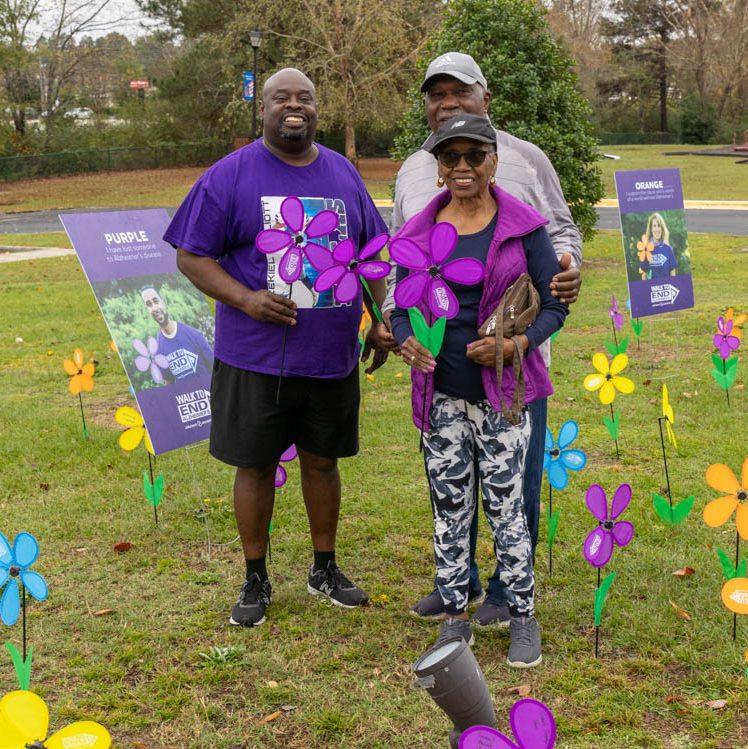
Looking back on her caregiving experience, Charlie shares this for anyone serving as a caregiver for their loved one living with Alzheimer’s, “Keep in mind their behavior is the disease, not the person. Don’t take anything they say or do personally. Reach out to the Alzheimer’s Association if you need anything and they will be there for you every step of the journey.”
Becoming active in the Moore County Senior Enrichment Center following her move, Charlie learned of the Walk to End Alzheimer’s in 2019. Inspired to honor her father and stepmother, she has faithfully participated every year since. She encourages her friends and family to contribute to her fundraising efforts through her Facebook fundraiser and personal outreach. With more members of her family being diagnosed with the disease, Charlie is determined to help end Alzheimer’s and hopeful to see the White Promise Garden Flower — symbolizing the first survivor of Alzheimer’s disease — raised at on Walk Day in the near future.
According to Alzheimer’s Disease Facts and Figures, an annual report released by the Alzheimer’s Association, Black Americans are twice as likely as older Whites to have Alzheimer’s or another form of dementia. While we do not know the cause of this prevalence yet, researchers say higher rates of cardiovascular (heart and blood vessels) disease may contribute as a factor. Learn what the Alzheimer’s Association is doing to address disparities and provide care and support for Black Americans living with Alzheimer’s or another dementia.
LIKE CHARLIE, WE ALL HAVE A REASON TO FIGHT FOR A WORLD WITHOUT ALZHEIMER’S DISEASE. Join your local Walk to End Alzheimer’s today as an individual, team, or sponsor.
The Alzheimer’s Association hosts 17 walks across North Carolina. The Alzheimer’s Association Walk to End Alzheimer’s is the world’s largest event to raise awareness and funds for Alzheimer’s care, support and research. Since 1989, the Alzheimer’s Association® mobilized millions of Americans in the Alzheimer’s Association Memory Walk®; now the Alzheimer’s Association is continuing to lead the way with Walk to End Alzheimer’s. Together, we can end Alzheimer’s.
| Alamance County | 9/30/2023 |
| Asheville | 10/14/2023 |
| Charlotte | 10/21/2023 |
| Fayetteville | 10/28/2023 |
| Gaston/Cleveland/Lincoln | 10/14/2023 |
| Guilford County | 10/7/2023 |
| Henderson County | 9/30/2023 |
| Iredell County | 9/23/2023 |
| Jacksonville | 10/14/2023 |
| Moore County | 9/30/2023 |
| Mount Airy | 9/9/2023 |
| New Bern | 10/21/2023 |
| Rowan-Cabarrus | 10/28/2023 |
| Unifour (formerly Hickory) | 10/28/2023 |
| Triangle (Raleigh-Durham) | 10/7/2023 |
| Wilmington | 11/4/2023 |
| Winston-Salem | 11/4/2023 |
 Alzheimer's Association North Carolina Blog