
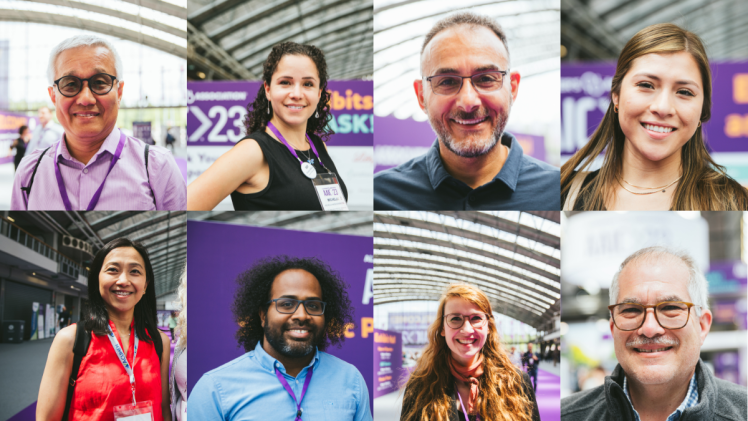
A report on the 2023 Alzheimer’s Association International Conference (AAIC) by Jill Disney, a staff research champion for NC, SC & GA.
AAIC 2023 may be over, but there is so much hope and excitement to take from the research presented this year. More than 10,000 attendees from around the world participated in-person in Amsterdam and virtually, highlighting the truly global nature of this conference.
If you tuned into the nightly news or read leading newspapers at the end of July, you probably saw some of these headlines.
- Full phase 3 results for donanamab announced at AAIC 2023 offer more hope for those living with early stage Alzheimer’s. Nearly half of participants at the earliest stage of the disease who received the treatment had no decline at one year.
- Findings revealed at AAIC 2023 showed a connection between chronic constipation and worsening cognition, as well as gut bacteria that may add to risk.
- A simple finger-prick blood test may revolutionize the diagnosis of Alzheimer’s, perhaps even making it possible to test at home.
- The east and southeastern United States have the highest estimated prevalence of Alzheimer’s dementia, according to a first-ever study of occurrence of the disease by U.S. counties. In North Carolina, this new data shows every county in the state having a prevalence rate of 8.9 percent or higher in their in their 65+ population.
- Research has found that hearing aids may cut risk of cognitive decline by nearly half for older adults who had hearing problems and who were at higher risk of cognitive decline.
- A new study found adults who volunteered late in life had better cognitive function – especially when looking at planning, decision making, and memory.
- New gene-editing strategies offer hope for next-generation Alzheimer’s treatments, including reducing levels of the most common risk gene and lowering production of a toxic protein in the brain. Researchers from Duke University Center for Advanced Genomic Technology presented on this new gene editing technology.
Equally as exciting is noticing names of leaders from across the Southeast leading scientific sessions and sharing their posters. Of the more than 3,000 scientific presentations from the conference, 117 presentations were from North Carolina-based researchers and investigators from: Duke University, East Carolina University, NC State University, North Carolina A&T University, several campuses of the University of North Carolina System, Wake Forest University and other research centers.
Here’s just a few of those regional standouts:
Equally as exciting is noticing names of leaders from across the Southeast leading scientific sessions and sharing their posters.
North Carolina’s own Dr. Laura Baker from Wake Forest University School of Medicine shared an update on the Alzheimer’s Association funded U.S. POINTER study which has successfully enrolled 2,000 participants, 30% of whom are from underrepresented groups. Be on the lookout for results from this study in just a couple of years to learn more about lifestyle interventions that may reduce dementia risk and create healthier communities. Sleep is something that many people struggle with, and we’re learning more about how poor sleep quality may impact dementia risk. Dr. Ashley Sanderlin from North Carolina Agricultural & Technical State University presented her work “Ketogenic Dietary Effects of Sleep, Cognition and Behavior in MCI: Baseline Sleep Results” in a poster.
Dr. Sue Levkoff from the University of South Carolina shared her work in a poster session titled “Emerging Strategies for Developing Highly Engaging Dementia Care Interventions for Paid Care Workers in Long-Term Care (LTC) Settings.” Learning how to address challenges in the LTC workforce is critical to ensuring quality care for our loved ones with dementia. And Dr. Fan Hongkuan from the Medical University of South Carolina shared work entitled “Vascular Dysfunction as a Potential Link Between Infection and Alzheimer’s Disease.”
From Georgia, Dr. Glenna Brewster from the Emory University, Neil Hodgson Woodruff School of Nursing shared her research on promoting caregiver mastery in Black dementia caregivers. Dr. Chinkuli Mumkombwe from the Neuroscience Department at Georgia State University shared research about Alzheimer’s Disease neuroimaging biomarkers in a mid-life, racially-diverse high-risk cohort.
The more we know about the possible causes of Alzheimer’s, ways to detect it earlier and easier, and ways to reduce our risk are all important steps toward a cure. Until that time, learning about how to provide the best care for those living with dementia and to meet the needs of caregivers helps us provide the support that those affected by this disease need.
AAIC 2024 may be a year away, but the work to find answers doesn’t stop as long as scientists are hard at work and the Alzheimer’s Association is committed to making this a world without Alzheimer’s and all other dementia. At any given moment, research is happening. Right now, the Alzheimer’s Association has over $320 million invested in more than 1,000 research projects in 54 countries, spanning six continents. Visit alz.org/anygivenmoment to learn more.
About the Alzheimer’s Association International Conference (AAIC)
AAIC is the largest and most influential international meeting dedicated to advancing dementia science. Each year, AAIC convenes the world’s leading basic science and clinical researchers, next-generation investigators, clinicians and the care research community to share research discoveries that’ll lead to methods of prevention and treatment and improvements in the diagnosis of Alzheimer’s disease. Read more about the highlights from AAIC23.
 Alzheimer's Association North Carolina Blog