

“Imagine: You can’t remember your own child’s name, or even your own name. You can’t express your need to use the restroom or even explain that your chest hurts,” begins Tommy Macon of Fayetteville, NC. “This is the daily reality for those living with Alzheimer’s and other dementia.” For Tommy’s family, this wasn’t just a scenario to imagine; it was their harsh reality on their mother’s journey with Alzheimer’s.
Susie B. Macon was a professional seamstress, known for her exquisite suits. Even after retirement, she continued to create beautiful items for friends, family and her church. “I must have inherited my mom’s skill for sewing,” reflects Tommy. “I enjoy making quilts and other crafts.” Susie was always helping others, especially those living alone or widowed, by bringing them groceries or whatever else they might need. Tommy recalls the delicious homemade soups his mother made and her thoughtful and relentless drive to give back. Additionally, Susie sang in the church choir and served as a chief usher. “Mom’s the reason I’m still an usher on the usher board today,” asserts Tommy. “She started me young and made me do it, even when I didn’t want to.”
In 2013, Tommy and his family noticed Susie becoming forgetful. At 78 years of age, she was living alone, but beginning to isolate herself and repeat her stories. Tommy and his four siblings took turns caring for their mother, rotating houses, including Susie’s, who was fiercely trying to maintain her independence as long as she could. However, as her Alzheimer’s progressed, it was apparent that she needed the stability of a full-time caregiver. In 2014, the family elected Tommy as that primary caregiver. A role he and his wife, Gloria were happy to do.
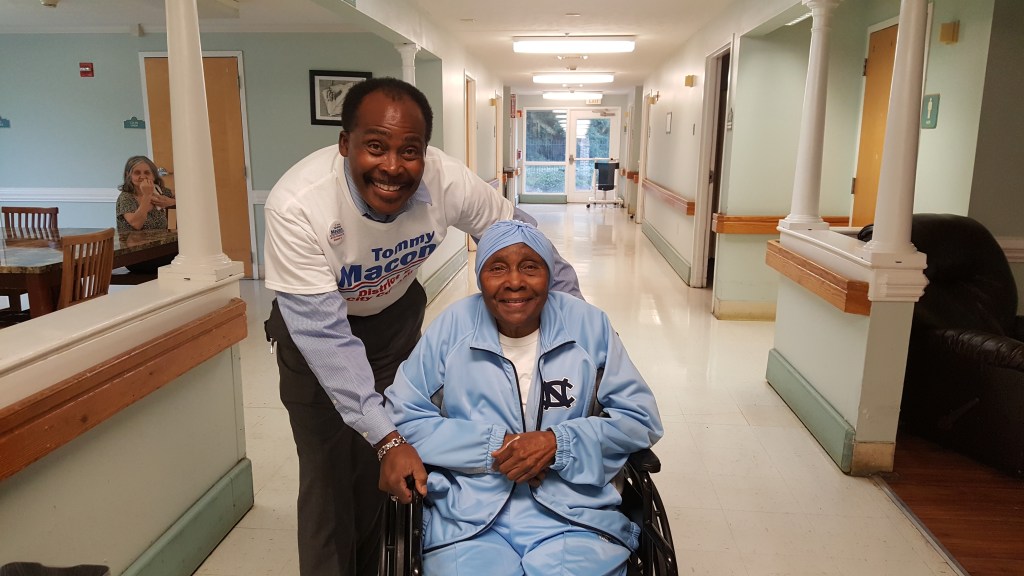
Initially, caring for Susie at home went well, but as her condition progressed, it became overwhelming. Balancing a full-time job and caring for his mother became too much, especially when she stopped eating and drinking. A call to 911 for dehydration and her increasing sundowning periods made it clear to Tommy and Gloria that Susie needed to be in a care facility to help with her medical care. In 2016, Susie moved to a care facility, where she remained until her passing in late November 2019 at the age of 86.
Tommy’s relationship with the Alzheimer’s Association grew through his caregiving experience with his mom. “I quickly learned how devastating dementia can be,” says Tommy. “It not only takes away a person’s sense of humanity, but also has debilitating effects as well.” He wanted to learn as much as possible to be the best caregiver for his mother and to understand what was being done to eradicate this disease, and how he could help.

Tommy’s volunteer work as a mission presenter and then his first time participating in the 2018 Walk to End Alzheimer’s – Fayetteville only deepened his sense of ownership and proactive stance in the future elimination of Alzheimer’s disease and all other dementia. Since then, Tommy and his family have been unwavering supporters of the Walk and look forward to participating in the Fayetteville Walk on October 26 at Segra Stadium. Over the years, they have formed multiple teams and successfully fundraised through their countless connections in the military, school systems and church communities. “The ‘I scratch your back if you scratch mine’ principle has worked well for our teams,” says Tommy. His favorite parts of Walk are community engagement, the number of volunteers willing to help, and listening to caregivers share their experiences.

Tommy believes the Alzheimer’s Association Helpline (800-272-3900) has proven invaluable, not only for him, but for others seeking resources to care for loved ones with Alzheimer’s or other dementia. “There are so many questions that evolve when you’re a caregiver,” shares Tommy. “Speaking with someone who can help you navigate the tumultuous Alzheimer’s journey is incredibly beneficial.”
Tommy encourages everyone to get involved with Walk to End Alzheimer’s. Everyone can help us extinguish this awful disease by volunteering or helping to raise funds. In closing, Tommy echoes his late mother’s words: “Do what you can, while you can, because you can.’ “
LIKE TOMMY, WE ALL HAVE A REASON TO FIGHT FOR A WORLD WITHOUT ALZHEIMER’S DISEASE. Join your local Walk to End Alzheimer’s today as an individual, team, or sponsor.
The Alzheimer’s Association hosts 17 walks across North Carolina. The Alzheimer’s Association Walk to End Alzheimer’s is the world’s largest event to raise awareness and funds for Alzheimer’s care, support and research. Since 1989, the Alzheimer’s Association® mobilized millions of Americans in the Alzheimer’s Association Memory Walk®; now the Alzheimer’s Association is continuing to lead the way with Walk to End Alzheimer’s. Together, we can end Alzheimer’s.
| Alamance County | 9/28/2024 |
| Asheville | 10/5/2024 |
| Charlotte | 10/19/2024 |
| Fayetteville | 10/26/2024 |
| Gaston/Cleveland/Lincoln | 10/5/2024 |
| Guilford County | 10/5/2024 |
| Henderson County | 9/21/2024 |
| Iredell Co. & Lake Norman | 9/21/2024 |
| Jacksonville | 9/28/2024 |
| Moore County | 9/14/2024 |
| Mount Airy | 9/14/2024 |
| New Bern | 10/19/2024 |
| Rowan-Cabarrus | 9/21/2024 |
| Unifour | 10/26/2024 |
| Triangle (Raleigh-Durham) | 10/5/2024 |
| Wilmington | 11/2/2024 |
| Winston-Salem | 11/2/2024 |
 Alzheimer's Association North Carolina Blog