
By Sarah Osment
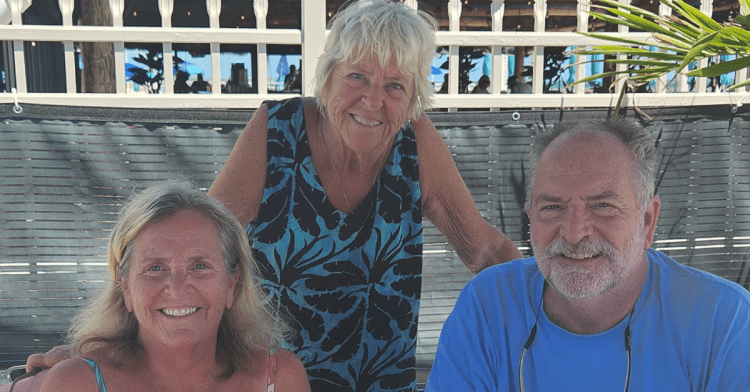
Alzheimer’s has woven itself into the fabric of June Lederle’s family story – touching generations and reshaping lives. Her daughter-in-law, Ellen, lost her mother to the disease. Ellen’s oldest sister was diagnosed with younger-onset Alzheimer’s at 58. Then, in 2019, June’s own daughter, Cathie, received the same diagnosis – at the very same age.
Today, Cathie lives with her mom June in Wilmington, NC, who became her full-time caregiver in 2024. “It’s been a reverse role play,” said June. “Cathie now lives with me, and I am her caregiver. I never imagined myself in this role. I had a beautiful, 64-year marriage with a wonderful man who gave me strength. Now, my purpose is to give Cathie as full a life as I can, with compassion for her limitations.”

Before her diagnosis, Cathie built a successful career in technical fields. A graduate of Elon University, she began her career at IBM – where her father had also thrived – then moved to Hewlett-Packard, working in California as a product line marketer. “She had a beautiful son while in California, who’s now 25 and a wonderful young man,” said June.
Cathie was working at Dell when her symptoms began to surface. “Her performance was slipping, and it became clear something wasn’t right,” June recalled. “She tried so hard – writing feverishly in notebooks to remember what she heard. She knew she wasn’t herself, but we didn’t know why until cognitive testing confirmed it.”
Living in Richmond, VA, Cathie enrolled in a clinical trial at the National Clinical Research Group. “It was a double-blind study – we didn’t know if she was receiving the drug or a placebo,” said June. In 2022, the FDA approved Leqembi, the drug used in the trial. “We later learned Cathie had received the placebo, but she was eligible to begin the actual treatment,” said June.
Leqembi is a monoclonal antibody that targets and clears amyloid-beta plaques from the brain – one of the hallmarks of Alzheimer’s. “With the scans, they could see the plaque disappearing,” said June. “She finished the study in August, and the plaque is gone. It feels like we’ve been given a placeholder in time. Now we wait to see if the disease will continue its devastating course.”
Cathie’s day-to-day behavior has stabilized. “Whether it’s the drug or something else, no one knows,” said June. “We’re just grateful for each day.”
Cathie had the opportunity to test an auto-injection method of Leqembi, and they hope she’ll be able to continue this simplified treatment. “The progress that’s been made in treating this disease has been incredible,” shares June. “And we will continue to make progress giving us even better opportunities to fight this horrible disease.”
Cathie has been living with June for a year now. “I try to keep her busy – we go for walks, visit museums,” said June. “If she sees me take interest in something, she joins in. Sometimes it’s like reverting back to when she was 15 years old. If she gets upset, it’s like a teenager mad at mom. It’s stressful, and I try hard to avoid those triggers.”
June is no stranger to caregiving. “My husband was a professional athlete, but the last 20 years of his life, he wasn’t easily mobile. Caregiving requires a reinvention of yourself. Your routine disappears and you have to learn to be part of their life, rather than trying to incorporate them into your own. I’m glad to be able to do it.”

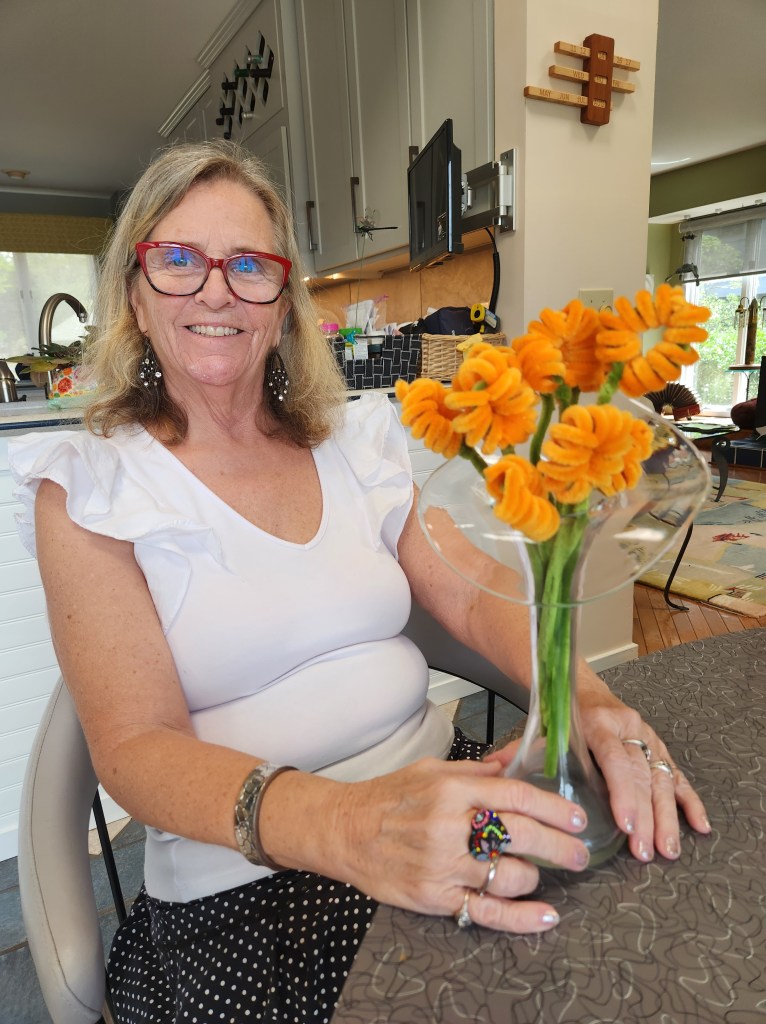
June finds joy in helping Cathie reconnect with her lifelong interests. “Cathie has always had a creative spark,” said June. “As her Alzheimer’s progressed, she began crafting – especially around holidays. Now, if I set up the environment, she’ll spend hours making beautiful things.”
They’ve turned crafting into a way to give back. “Last fall, we made pumpkins and took them to the Autumn Hall Memory Center. Last spring, we made fairy garden sticks. Now we’re working on Halloween vases with pipe cleaners and pumpkin flowers. Crafting helps her focus and brings joy.”
June also encourages Cathie to socialize through a monthly greeting card crafting class. In addition to making cards, they listen to music. “Cathie can sing lyrics from her era, she taps her foot and lights up. I’m told that comes from a different part of the brain.”
Family support is central to their journey. June’s son, Walt, and his wife, Ellen, regularly include them in activities. This fall, they’ll walk together in the local Walk to End Alzheimer’s – Wilmington.
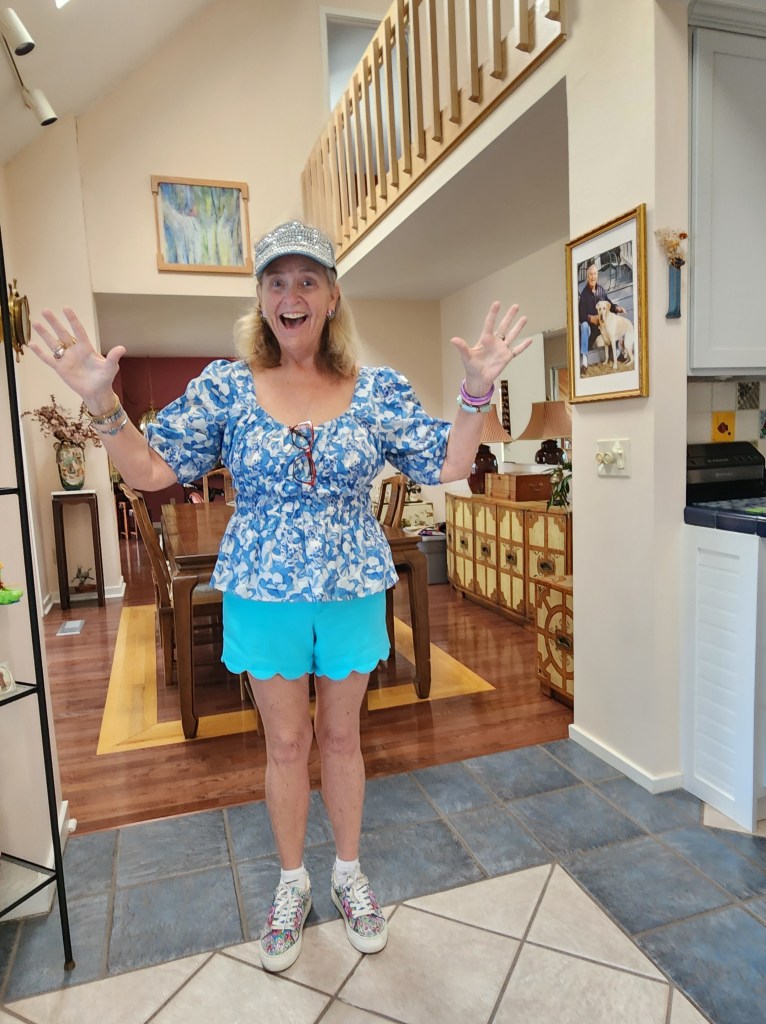
“Ellen and her sisters started walking in D.C. in memory of their mom and became successful fundraisers,” said June. “When Cathie came to live with me, Ellen said, ‘Let’s make a team in Wilmington.’ I think it’s wonderful that Walks are happening all over the country.”
June sees the Walk as a way to raise awareness and honor those living with Alzheimer’s. “It’s great to see communities come together. There are so many people with Alzheimer’s who are still capable, still here. We need to honor them.”
She encourages others to get involved and learn more. “If you notice a loved one struggling to focus or sense a cognitive decline, I encourage you to help them speak with their doctor. The earlier the diagnosis, the more opportunity for treatment options,” shares June. “Get involved with the Alzheimer’s Association and find ways to connect with your community.”
LIKE JUNE, WE ALL HAVE A REASON TO FIGHT FOR A WORLD WITHOUT ALZHEIMER’S DISEASE. Join your local Walk to End Alzheimer’s today as an individual, team, or sponsor.
The Alzheimer’s Association hosts 17 walks across North Carolina. The Alzheimer’s Association Walk to End Alzheimer’s is the world’s largest event to raise awareness and funds for Alzheimer’s care, support and research. Since 1989, the Alzheimer’s Association® mobilized millions of Americans in the Alzheimer’s Association Memory Walk®; now the Alzheimer’s Association is continuing to lead the way with Walk to End Alzheimer’s. Together, we can end Alzheimer’s.
Walk to End Alzheimer’s 2025 dates in North Carolina:
| Alamance County | 9/27/25 |
| Asheville | 9/27/25 |
| Charlotte | 10/18/25 |
| Fayetteville | 10/25/25 |
| Gaston/Cleveland/Lincoln | 10/11/25 |
| Guilford County | 10/25/25 |
| Henderson County | 9/27/25 |
| Iredell Co. & Lake Norman | 9/27/25 |
| Jacksonville | 9/27/25 |
| Moore County | 9/13/25 |
| Mount Airy | 9/20/25 |
| New Bern | 10/18/25 |
| Rowan-Cabarrus | 10/4/25 |
| Unifour | 10/25/25 |
| Triangle (Raleigh-Durham) | 10/4/25 |
| Wilmington | 11/1/25 |
| Winston-Salem | 11/16/25 |
Join us in our fight for a future without Alzheimer’s and all other dementia.
About the author: Sarah Osment

Sarah is a strategic communications professional with more than a decade of experience in media relations, content creation and social media. She’s served on the marketing committee for Walk to End Alzheimer’s – Triangle since 2018.
 Alzheimer's Association North Carolina Blog