

A report on the 2024 Alzheimer’s Association International Conference (AAIC) by Taylor Wilson and Jill Disney, staff research champions for NC, SC & GA.
There is so much hope and excitement to take from the research presented at this year’s AAIC. Roughly 14,000 attendees from around the world participated in-person in Philadelphia and virtually, highlighting the truly global nature of this conference. Among attendees were our Chapter Executives and Research Champions from across the Carolinas and Georgia. They participated in a Research Mission Immersion program where they were able to sit in on presentations, meet researchers, and get a breakdown of the research to share back home with stakeholders.
If you tuned into any national news July 28 – August 1, you probably saw some of these headlines.
- Blood tests may revolutionize accuracy of Alzheimer’s disease diagnosis and help people get diagnosed and treated more quickly.
- GLP-1 agonists are a successful class of drugs shown to help with type 2 diabetes, weight loss and reduce the risk of heart disease. Protecting the brain may also be a benefit. In people with mild Alzheimer’s dementia, GLP-1 agonist liraglutide (Novo Nordisk) reduced shrinking by nearly 50% in parts of the brain that affect memory, learning, language, and decision-making, compared to placebo.
- People who eat about two servings a week of processed red meat have a 14% higher risk of dementia than those who eat less than three servings a month, according to research. Replacing one serving of processed red meat every day with one serving of nuts and legumes can lower the risk of dementia by about 20%.
- Wildfire smoke riskier for brain than other types of air pollution, such a motor vehicles and factories.
Of the thousands of scientific presentations from around the world at AAIC, 100 presentations and posters were from North Carolina-based researchers and investigators from including: Duke University, several campuses of the University of North Carolina System, Wake Forest University and other research centers.
AAIC 2024 kicked off with an opportunity for our Research Champions and Chapter Executives to have dinner with newly #ALZFunded researchers, or those researchers who have recently received funding from the Alzheimer’s Association to further their projects.
Some of these regional standouts include:
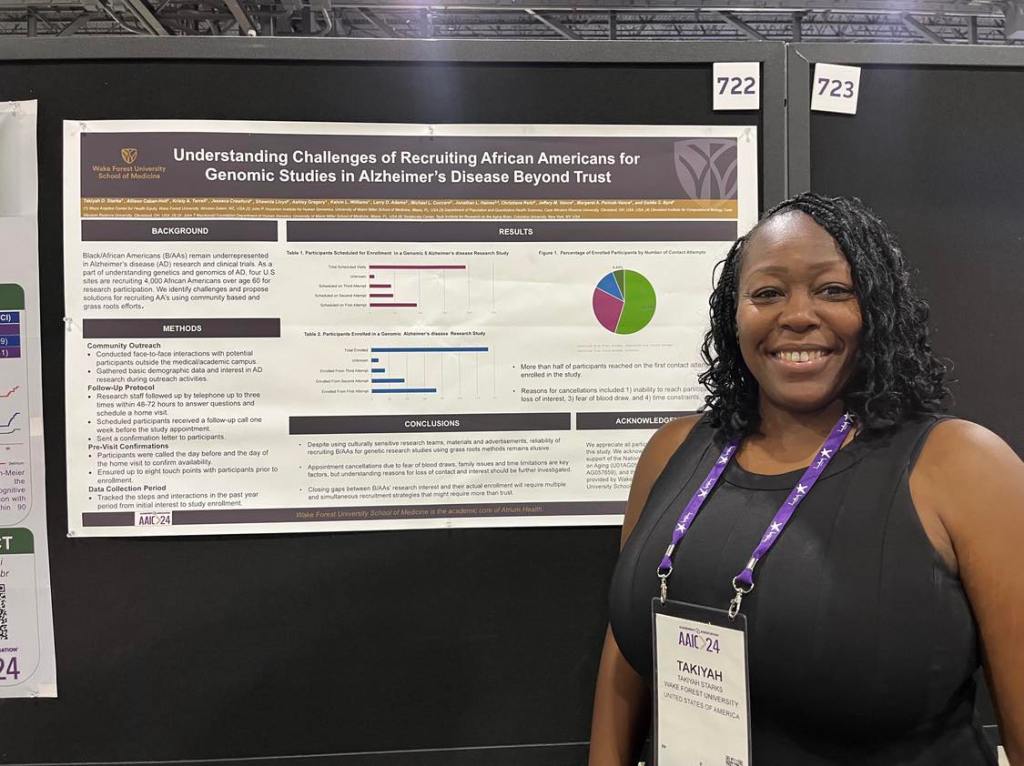
North Carolina-based researcher, Takiyah Starks serves as a project manager for the Wake Forest University School of Medicine’s Maya Angelou Center for Health Equity. Her research is focused in genetics of Alzheimer’s disease, particularly African Americans and underrepresented populations. Ms. Starks was first interviewed in San Diego at AAIC 2022 by research champions, and the work she presented then is still ongoing. Her presentation for AAIC in Philadelphia included detailed results on the barriers of recruiting African Americans to genomic studies. When asked about what is most exciting for her at AAIC this year as an #ALZFunded researcher, she shared “I think what I am most excited about are the diverse groups of people that are attending this conference, as well as doing research in the Alzheimer’s space that will impact not only individuals in the United States, but individuals globally. So I think we have more researchers that are willing to engage and incorporate and be more inclusive with some of our communities of color.”
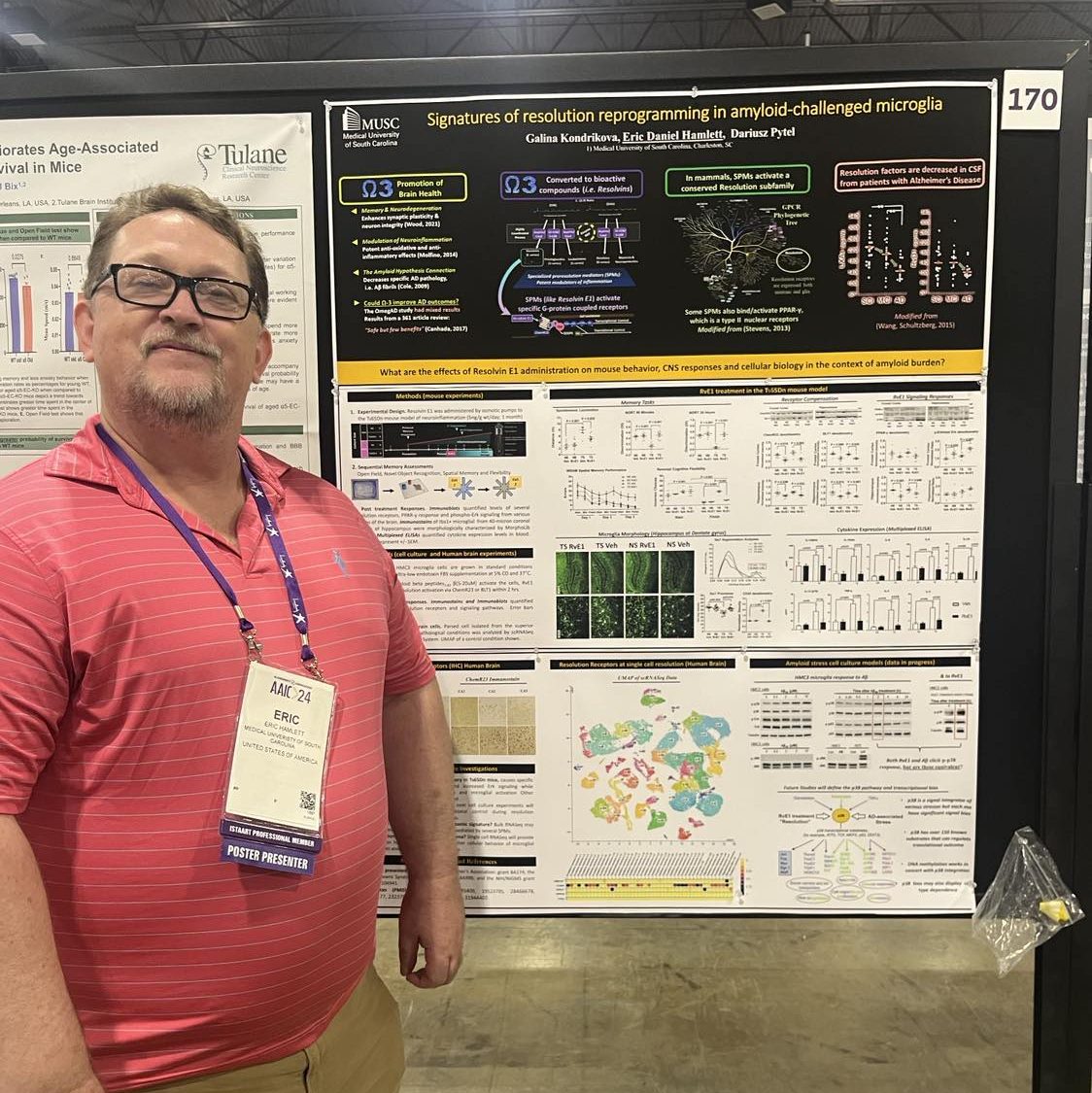
From South Carolina, Dr. Eric Hamlett is no stranger to the Alzheimer’s Association, attending Walk to End Alzheimer’s – Charleston in 2022 with the Medical University of South Carolina to be present at their information table. He is also not a stranger to Alzheimer’s Association science, being one of the #ALZFunded researchers presenting for South Carolina. For his time at AAIC in Pittsburgh this year, he shared about his research around supplements and aging, noting that not all supplements are absorbed the same way into the body as you age, particularly, for his research, Omega 3. Dr. Hamlett is working on research that would move around the age barrier to allow the Omega 3, delivered in a different way, to have the same brain health protection that it has in earlier life. Dr. Hamlett shared his thoughts about AAIC early in the conference, stating, “I am excited about some of the newer technologies that are occurring around biomarkers and monitoring of progression of the disease directly from the blood, and some new improvements that have been made in imaging.”
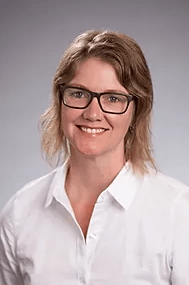
Georgia researcher, Dr. Whitney Wharton is a proud #ALZfunded researcher whose lab at Emory University’s School of Nursing was well-represented at AAIC this year. Dr. Wharton presented on her work to engage sexual and gender minority caregivers of Alzheimer’s and related dementias through the work she leads with Dr. Jason Flatt of UNLV and Dr. Joel Anderson of UTK on the R.I.S.E. Registry (Research Inclusion Supports Equity). In addition to better understanding the need of SGM ADRD caregivers, this community participatory based research also aims to help other researchers design their data collection practices to allow the research community to learn more about LGTBQ+ caregivers and people living with dementia. As evidence of the breadth of research they lead in Atlanta, the Wharton Lab also had a poster presented by Dr. Brittany Butts and Enid Swatson, MPH about lumbar puncture for research procedures as this is a standard biomarker used with participants.
AAIC is the largest and most influential international meeting dedicated to advancing dementia science. Each year, AAIC convenes the world’s leading basic science and clinical researchers, next-generation investigators, clinicians and the care research community to share research discoveries that’ll lead to methods of prevention and treatment and improvements in the diagnosis of Alzheimer’s disease. Read more about the highlights from AAIC24.
 Alzheimer's Association North Carolina Blog